
 Business License
Selecting Hardfacing Flux Core Wire: 7 Key Parameters to Evaluate Before Buying
A steel mill maintenance manager ordered a low-priced hardfacing wire for rebuilding crusher hammers, attracted by a price roughly 30% below the wire his team usually used. The rebuilt hammers lasted barely half as long as the previous batch. The mill's labor cost for the rebuild was identical, but the hammers failed twice as often, and the savings on wire were lost many times over in downtime.
The price difference came from the wire's chemistry and construction — not from the label. Hardfacing flux core wire is a precision product, and small differences in alloy content produce large differences in deposit performance. This guide walks through the seven parameters that determine whether a wire is right for your job, and how to compare quotes on a factual basis.
1. Why Wire Selection Matters
The wire determines the wear resistance of every rebuilt surface it deposits. Choose a wire matched to the wear mechanism — abrasion, impact, or a combination — and the part serves its full life. Choose the wrong one and the deposit fails early, no matter how well the welding was done.
Hardfacing flux core wire is also one of the larger recurring consumable costs in a maintenance shop. A systematic selection process converts that spend from a gamble into a calculated decision, and it gives procurement a defensible basis for comparing suppliers.
2. The 7 Parameters at a Glance
Seven factors separate a suitable wire from a cheap one. They are summarized below, then examined one by one.
| # | Parameter | What It Determines |
|---|---|---|
| 1 | Hardness target | Deposit hardness in HRC, matched to the abrasive |
| 2 | Carbide content and alloy type | Wear mechanism matched — abrasion vs. impact |
| 3 | Wire diameter | Deposition rate and practical welding current |
| 4 | Shielding type | On-site logistics: gas supply or self-shielded |
| 5 | Operating parameters | Amperage, voltage, and position capability |
| 6 | Dilution and pass count | Final deposit chemistry and hardness |
| 7 | Cost per deposited kilogram | True economics, not package price |
3. Parameter 1 and 2: Hardness Target, Carbide Content, and Alloy Type
Hardness is the first filter. Most chromium carbide hardfacing wires are formulated to deposit in the 50 to 65 HRC range, and the target should match the abrasive's hardness. For mineral abrasion such as quartz-bearing ores, deposits at the upper end of the range are typical; for softer abrasives or mixed wear, a slightly lower hardness with more toughness is often a better choice.
Carbide content follows from the alloy formulation. Wires with higher carbon and chromium — typically 4% to 6% carbon and 22% to 32% chromium — form more Cr₇C₃ particles and wear longer under pure abrasion. Formulations with additions such as manganese and boron trade some hardness for impact resistance.
The alloy type must match the wear mechanism. A crusher hammer that sees heavy impact needs a tougher deposit; a chute liner that sees sliding abrasion needs maximum carbide. The same wire cannot do both jobs well, and a supplier's data sheet states which duty each wire is designed for.
Read the data sheet carefully, because two numbers look similar but mean different things. Rated hardness refers to the deposit produced under the manufacturer's test conditions, usually on a specified base metal with a specified pass count. Field deposits on a different base metal, or in a different position, can measure several HRC lower. Asking the supplier to confirm the exact test conditions prevents surprises at the hardness tester.
4. Parameter 3: Wire Diameter and Deposition Rate
Wire diameter controls how fast metal is deposited. Common diameters are 1.6 mm, 2.0 mm, 2.4 mm, 2.8 mm, and 3.2 mm, and the deposition rate rises with diameter because larger wires carry more current.
A 2.8 mm wire may deposit roughly 6 to 9 kg of weld metal per hour, while a 1.6 mm wire deposits only 2 to 3 kg per hour under typical conditions. For large-area overlays, the larger diameter is essential; for small parts and fine work, the smaller diameter gives the needed control.
The equipment must match the wire. Confirm that your welding machine delivers the amperage the wire requires, typically 250 to 600 A for large-diameter hardfacing wires.
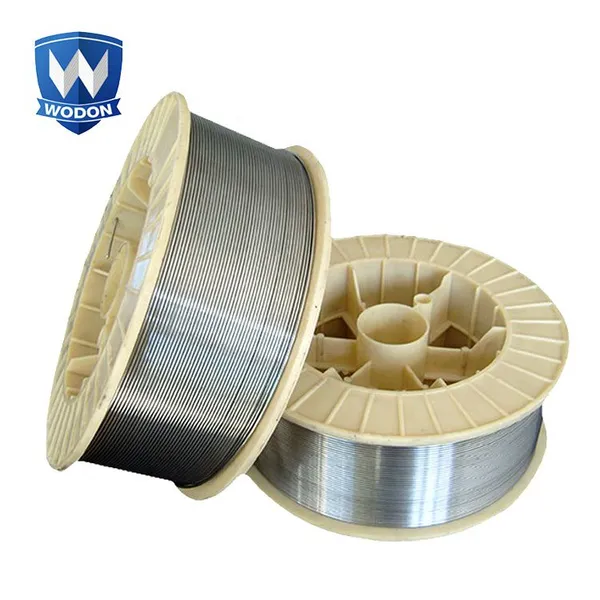
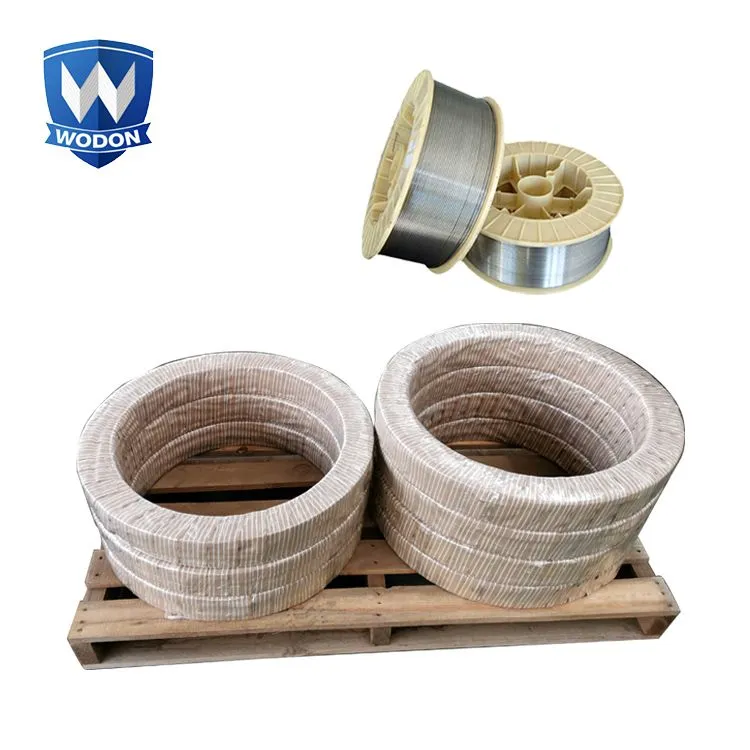
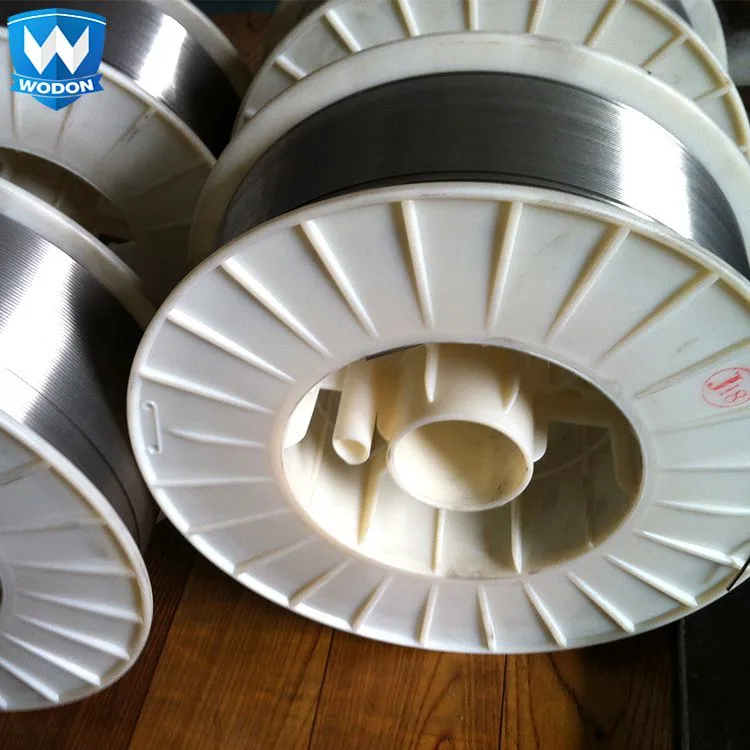
Feed stability is part of the equation. Flux core wire is a tubular product, and a consistent fill keeps the arc steady during long runs. Check that the wire feeds smoothly through your gun and liner, and confirm the supplier's recommended stick-out length — typically 20 to 35 mm for self-shielded hardfacing wires — before starting production.
5. Parameter 4: Shielding Type — Self-Shielded or Gas-Shielded
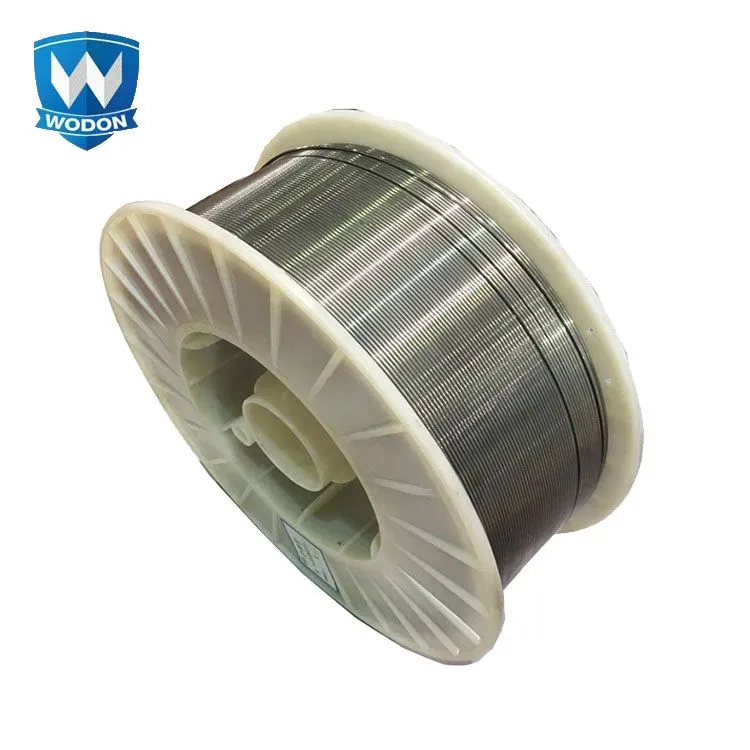
Shielding determines where and how the wire can be used. Self-shielded (open arc) flux core wire generates its own protective slag and gas, so it runs outdoors and in the field without a gas cylinder. It is the standard choice for hardfacing wear plate production and large rebuilds.
Gas-shielded wire requires a CO₂ or argon-CO₂ supply and cleaner site conditions. It produces a cleaner deposit with less fume and is favored in controlled workshop environments.
The choice is mostly logistical. For a mine-site workshop with limited shielding gas supply, self-shielded wire is the practical option; for a fixed fabrication shop, gas-shielded wire offers cosmetic and cleanliness advantages.
6. Parameter 5: Operating Parameters and Welding Position
Every wire has a specified current and voltage window. Operating outside it changes the deposit: too low a current gives poor fusion and porosity; too high a current adds dilution and softens the overlay. The manufacturer's recommended settings are the starting point, and a short welding trial confirms them on your equipment.
Position capability also matters. Most hardfacing wires are designed for flat and horizontal positions, where the puddle can be controlled. Vertical and overhead hardfacing require specialized wires or techniques, and a wire bought for flat work will not perform reliably out of position.
Welding in the correct position with controlled interpass temperature is as important as the wire itself. Overheating a small part between passes can reduce the deposit hardness by several HRC points.
Consistency between batches is worth verifying at purchase time. Hardfacing wire is produced in continuous coils, and a reputable manufacturer controls the fill chemistry within tight limits. Requesting a coil certificate or batch analysis for the wire you receive gives your quality team a record against which the delivered deposit can be checked.
7. Parameter 6: Dilution and Pass Count
Dilution is the mixing of base metal into the first weld pass. On a mild steel part, the first pass may contain 15% to 25% base metal, which lowers the carbon and chromium concentration and softens the deposit. This is why single-pass overlays are softer than the wire's rated hardness.
A second pass deposits full-alloy metal on top, restoring the rated hardness and wear resistance. For critical surfaces, a two-pass or three-pass buildup is standard practice, and the wire's data sheet usually states the hardness for single and multi-pass deposits separately.
Preheat and interpass temperature control reduce cracking in thick deposits. Following the supplier's recommended preheat for the base metal grade prevents both hardness loss and weld defects.
8. Parameter 7: Cost per Deposited Kilogram
The package price is the least informative number on a wire quote. What matters is the cost per kilogram of metal actually deposited on the part, which depends on the wire's fill factor, deposition efficiency, and the number of passes needed to reach the target hardness.
| Cost Factor | What to Ask the Supplier |
|---|---|
| Fill factor | What is the actual metal content of the wire, typically 85–95%? |
| Deposition efficiency | What percentage of the wire becomes deposited metal, including spatter loss? |
| Pass count | Is the quoted hardness achieved in one pass or two? |
| Consumable extras | Is shielding gas, if required, included in the comparison? |
A wire that costs 10% more but reaches full hardness in one pass instead of two can be cheaper per part than the lower-priced option. Evaluating quotes on cost per deposited kilogram, not per kilogram of wire, gives procurement a true comparison.
Total cost should also include the labor and energy of each welding pass. At a typical duty cycle, a single-pass deposit on a large part can save several hours of welding time compared with a two-pass procedure. When the two options deliver the same final hardness, the faster one wins on shop-floor economics even if its unit price is higher.
9. A Practical Selection Checklist
The seven parameters condense into a short checklist that can be applied before any purchase. Working through it systematically prevents the most common buying mistakes.
| Step | Check |
|---|---|
| 1 | Define the wear mechanism: abrasion, impact, or mixed? |
| 2 | Set the target hardness range for the deposit. |
| 3 | Match alloy type and carbide content to the mechanism. |
| 4 | Select wire diameter for the deposition rate the job needs. |
| 5 | Choose shielding type based on site conditions. |
| 6 | Verify the machine can run the wire's current and position. |
| 7 | Confirm single-pass or multi-pass hardness values. |
| 8 | Compare quotes on cost per deposited kilogram. |
Jiangsu Wodon Wear Resistant New Material Co., Ltd. publishes hardness, chemical composition, and deposition data for its hardfacing flux core wire range, and the company's engineers assist with wire selection based on the part drawing and wear history. China Wodon supplies both the wire and the CCO wear plate made with the same alloy family, so a buyer can standardize consumables and plate across the plant.
10. A Case in Point: Crusher Hammer Rebuilding
An aggregate producer in the Middle East rebuilt crusher hammers with a general-purpose wire and saw hammer life of roughly six weeks. The wire's data sheet listed 52 HRC, but single-pass deposits measured 46 to 48 HRC in the mill's hardness testing — the dilution effect on a thin overlay.
The producer switched to a high-chromium hardfacing wire with a two-pass procedure. Deposits measured 58 to 61 HRC, and hammer life extended to roughly fourteen weeks. The wire cost about 20% more per kilogram, but the cost per tonne of crushed aggregate dropped by nearly 40% because rebuild frequency fell.
A second example is a power plant that had been using gas-shielded wire for clinker crusher pins. The plant moved the job outdoors with self-shielded wire, eliminating gas logistics, and achieved the same hardness and service life with a simpler setup.
11. FAQ: Selecting Hardfacing Flux Core Wire
11.1 How do I choose the hardness of hardfacing wire?
Match the deposit hardness to the abrasive rather than buying the hardest wire available. For mineral abrasion such as quartz, deposits of 55 to 65 HRC are typical. For impact-dominated wear, a tougher deposit in the 45 to 55 HRC range often outlasts a harder, more brittle one. The wear mechanism, not the maximum hardness number, should drive the choice.
11.2 What is the difference between self-shielded and gas-shielded flux core wire?
Self-shielded (open arc) wire generates its own protection from flux in the core, so it runs without external gas and suits outdoor or site work. Gas-shielded wire needs a CO₂ or argon-CO₂ supply and produces a cleaner deposit with less fume, which suits fixed workshop applications. Both can deposit chromium carbide overlays of similar hardness.
11.3 Why is my deposit softer than the wire's rated hardness?
The most common cause is dilution from the first pass. Base metal mixes into the first weld pass and lowers the carbon and chromium content, softening the deposit. Running a second pass, or increasing the welding current control, restores full hardness. Measuring hardness after each pass and comparing with the data sheet is the reliable way to confirm.
11.4 How should hardfacing flux core wire be stored?
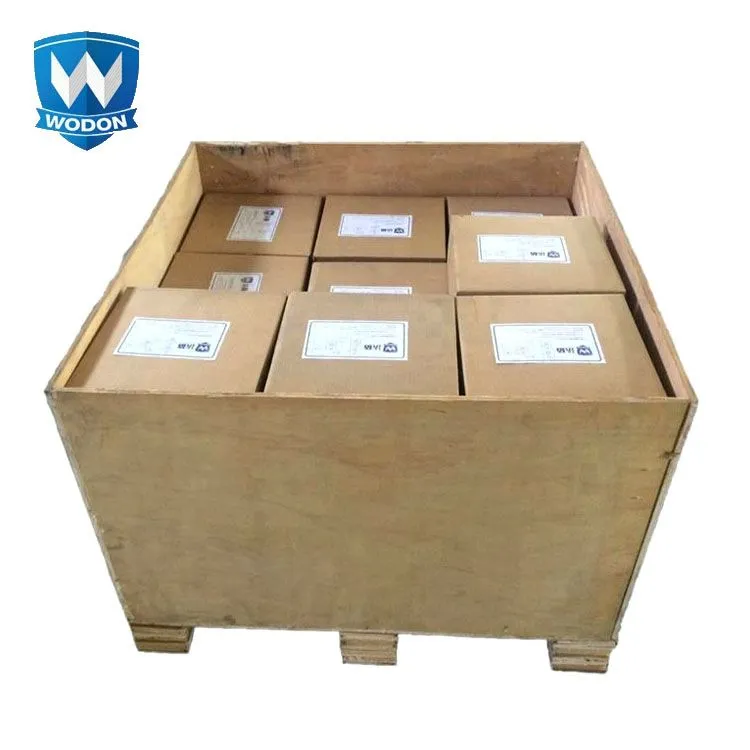
Flux core wire absorbs moisture, which causes porosity and hydrogen cracking in deposits. Store coils in their sealed packaging until use, in a dry area at a temperature above roughly 15°C. Wire that has been opened should be used promptly or kept in a heated cabinet. Follow the supplier's storage guidance to protect the deposit quality.
Recently Posted
-
Recent Advances in Chromium Carbide Overlay Technology: Higher Deposition Rates and Finer Microstruc
September 4, 2026A wear plate buyer who ordered the same specification for a decade might assume the product has not changed. In reality, the chrom Read More
 -
Chromium Carbide Overlay Wear Plate in Cement Plants: Protecting Fans, Separators, and Ductwork
September 4, 2026A cement plant in North Africa was shutting down its raw mill fan every five months to patch holes worn through the fan casing and Read More
 -
CCO Wear Plate vs. Ceramic Alumina Lining: Which Solution Fits Your Abrasion Challenge?
September 3, 2026A quarry operator had lined the feed chute of his secondary crusher with ceramic alumina tiles. Within six weeks, the tiles in the Read More
 -
Understanding CCO Wear Plate: The Bimetallic Structure and Carbide Layer Explained
September 2, 2026A maintenance supervisor at a coal preparation plant watched his transfer chute fail for the fifth time in eighteen months. The 14 Read More

Contact Us
Recommended Products
-
 Chromium Carbide Overlay Wear Plate WD-1900 Smooth Surface CCO Wear PlateNegotiableMOQ: 1 Square Meter
 -
Hardfacing Wear Resistant Flux Cored Welding Wire With High HardnessNegotiableMOQ: 1 Kilogram
-
High Abrasion Resistant Hardfacing Wear Liners Chromium Carbide Overlay Cco Bimetallic Wear PlateNegotiableMOQ: 1 Square Meter
-
Chrome Carbide Wear Resisting Plate High Wear Steel Plate Wear Liner Platebimetallic Wearable Lining Plate Bucket ExcavatorCHF 300 - 300MOQ: 1 Square Meter
-
Wodon Customizable Steel Flux Cored Welding Wire Manufacturer's Valve Surfacing Gas Shielding OEM SupportUS$ 4.02 - 4.02MOQ: 1 Kilogram
-
Abrasive Resistence Wear Parts Overlay Carbon Chromium Steel PlateNegotiableMOQ: 1 Square Meter
-
Wear Plates for Heavy Duty Mining Applications High Chromium Carbide Overlay Abrasion Resistant and Customizable SizesNegotiableMOQ: 1 Square Meter
-
Hardfacing Truck Liner Plate Chromium Carbide Overlay Wear Plate Cladded PlateNegotiableMOQ: 1 Square Meter
-
Custom Overlaying Wear Plate - Economical Choice for Durable Industrial Applications, High-Quality Fabrication, 55HRC HardnessNegotiableMOQ: 1 Square Meter
-
Wear Abrasion Resistant Overlay High Carbon High Chromium Steel PlateNegotiableMOQ: 1 Square Meter
-
Wear Resistant Steel Plate 6mm 8mm 12mm Thickness Hot Rolled Carbon Steel Plate Wear PlateNegotiableMOQ: 1 Square Meter
-
Bimetallic Cco Clad Composite Overlay Hardfacing Wear Resistant Steel PlateNegotiableMOQ: 1 Square Meter
-
High-Performance Wear Plates for Cement Mills Chromium Carbide Overlay Long Service Life Reliable PerformanceNegotiableMOQ: 1 Square Meter
-
Wear Resistant Steel Plate Liners for Chutes Special Use Wear LinersNegotiableMOQ: 1 Square Meter
-
Cco Hardfacing Surfacing Tungsten Carbide Wear Resistant Plates Liner for SilosNegotiableMOQ: 1 Square Meter
-
Wodon Chromium Alloy Bimetal Hardfacing Plate for Mining MachineryCHF 300 - 300MOQ: 1 Square Meter
-
Hardfacing Abrasion High Wear Resistant Performance Cladding Plate TubeUS$ 399.69 - 399.69MOQ: 1 Square Meter
-
Hardfacing Plates for Manufacture Industry Value High Chrome Wear PlateUS$ 100 - 300MOQ: 1 Square Meter
-
Customizable OEM/ODM Wear-Resistant Soldering & Surfacing Flux Cored Welding WiresUS$ 9.9 - 9.9MOQ: 1 Kilogram
-
Chromium Carbide Round Pipe 6m and 12m Lengths Bending & Cutting Services Welding Technique Saw TechniqueUS$ 6 - 6MOQ: 1 Square Meter