
 Business License
CCO Wear Plate vs. Ceramic Alumina Lining: Which Solution Fits Your Abrasion Challenge?
A quarry operator had lined the feed chute of his secondary crusher with ceramic alumina tiles. Within six weeks, the tiles in the impact zone had shattered, and the exposed steel beneath was worn through in two months. A neighboring plant, running the same ore, had installed CCO wear plate instead and was still on its first liner set a year later.
The quarry operator's mistake was not choosing a poor product. Ceramic is an excellent wear material in the right service. The failure came from applying it where impact energy exceeded its toughness. This article compares chromium carbide overlay wear plate with ceramic alumina lining across the factors that matter in real plants, so you can match the material to your abrasion challenge.
1. Why This Comparison Matters
Ceramic lining and CCO wear plate are two of the most common answers to severe abrasion, yet they fail in completely different ways. Choosing between them is not about which is harder — it is about which failure mode your application can tolerate.
Ceramic fails by cracking and spalling when struck. CCO wear plate fails by gradual wear of a thick overlay. One is catastrophic and sudden; the other is gradual and predictable. For a maintenance planner, predictability is often worth more than peak hardness.
2. How Each Solution Works
Ceramic alumina lining consists of high-purity aluminum oxide tiles, typically 92% to 95% Al₂O₃, bonded to the steel shell with adhesive and held by welded anchor studs or dovetail rails. The tiles are extremely hard — roughly 1,200 to 1,600 HV — and highly resistant to scratching abrasion.
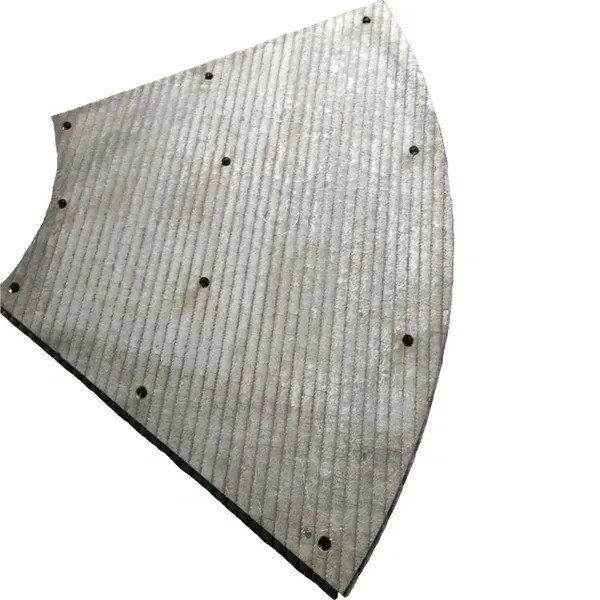
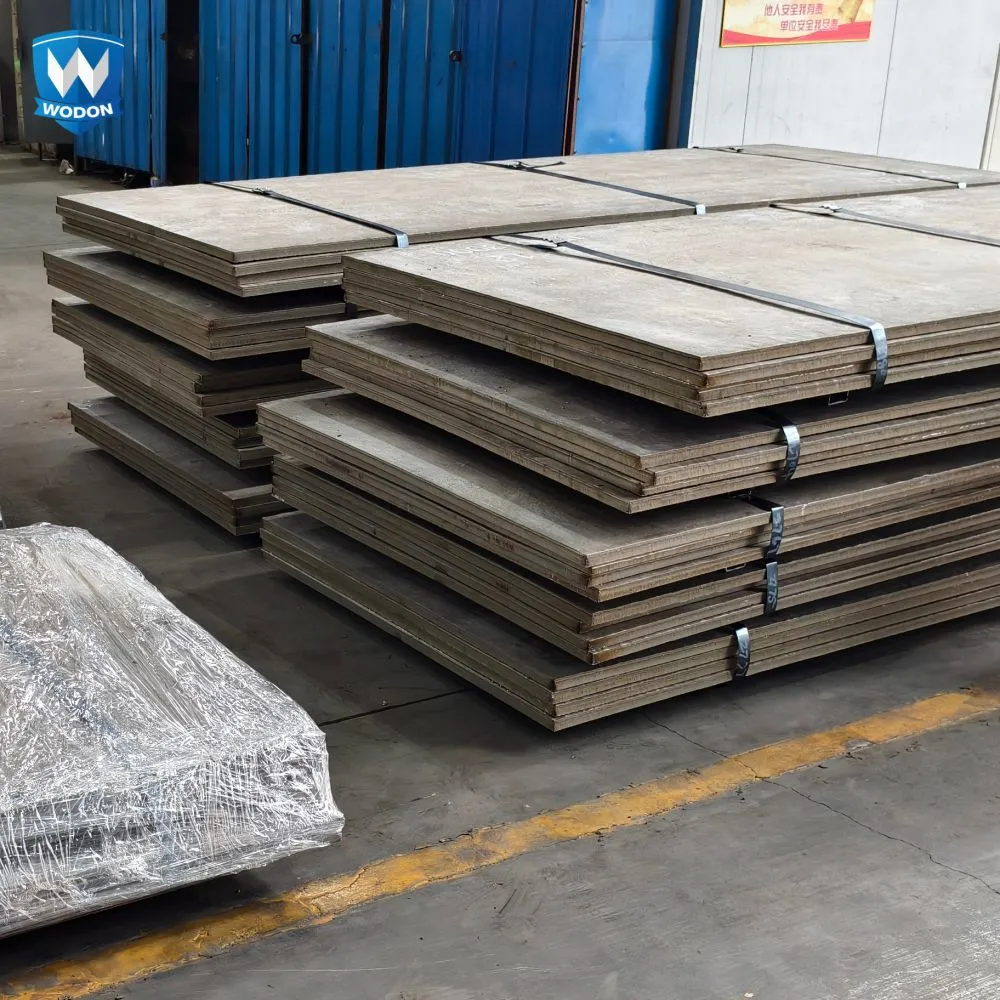
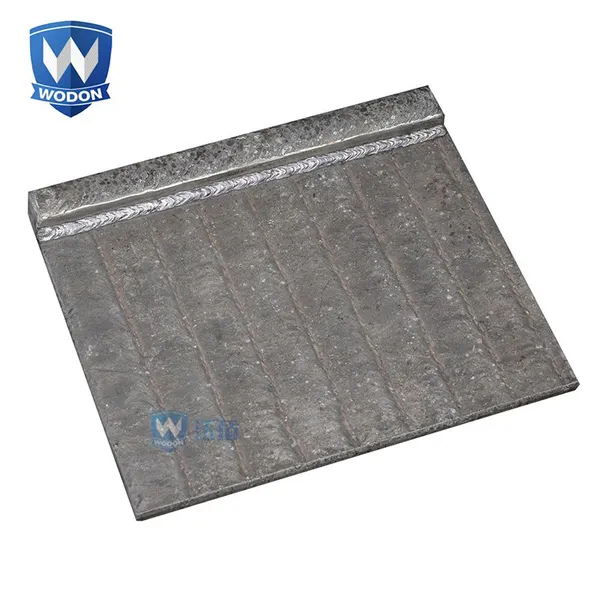
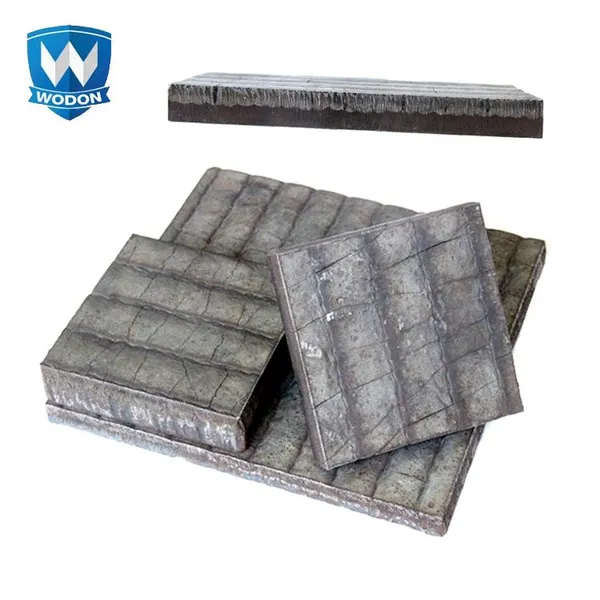
A CCO wear plate is a steel base plate with a weld-deposited chromium carbide overlay. The carbide particles reach roughly 1,400 to 1,800 HV, but they sit in a ductile iron matrix, and the whole plate sits on a tough structural steel base. This gives the working surface hardness comparable to ceramic, with impact tolerance that ceramic cannot match.
The two technologies therefore solve the same problem through opposite design philosophies: a brittle hard shell versus a hard composite with a tough foundation.
Both are manufactured as engineered products rather than raw materials. Ceramic tiles are pressed and sintered from alumina powder, with the tile quality controlled by density and porosity specifications. CCO wear plate is produced by automated open-arc welding with hardfacing flux core wire, where the overlay chemistry and welding parameters determine the carbide structure. China Wodon manufactures CCO wear plate in this manner, with hardness and carbide content verified on every production batch.
3. Abrasion Resistance Compared
In pure sliding abrasion with no impact — the ideal service for both materials — ceramic and CCO overlay perform at similar levels. Field tests in coal chutes and ash handling systems typically show both outlasting AR400 steel by a wide margin.
The difference appears as soon as the abrasive stream contains coarse particles or falls from height. Abrasive particles striking the surface at velocity generate micro-impacts that ceramic tiles absorb poorly. The same particles cut or deform the CCO overlay, which wears progressively but does not fail suddenly.
| Property | Ceramic Alumina Lining | CCO Wear Plate |
|---|---|---|
| Surface hardness | 1,200 – 1,600 HV | Carbides 1,400 – 1,800 HV, overlay 55 – 65 HRC |
| Sliding abrasion resistance | Excellent | Excellent |
| Impact tolerance | Low — cracks and spalls | High — base plate absorbs energy |
| Failure mode | Sudden, local spalling | Gradual, measurable wear |
In mixed wear — abrasion plus light impact — CCO wear plate consistently delivers a longer and more predictable service life than ceramic.
The wear mechanism explains why. Abrasive particles sliding at low angles cut the surface like a micro-machining operation, and both materials resist cutting well. At steeper angles, particles deform the surface instead.
Ceramic cannot deform; it fractures internally, and the damage accumulates until a tile spalls. The CCO overlay deforms plastically, converting impact energy into harmless local compression while the carbides continue to deflect cutting particles.
4. Impact Resistance: The Critical Difference
Impact is where the two materials diverge sharply. Ceramic alumina has almost no plastic deformation capacity. A single heavy impact can crack a tile, and once the crack forms, the tile spalls off within days, exposing the steel shell beneath.
The CCO overlay, by contrast, is designed for impact. The ductile matrix absorbs local deformation, and the steel base plate carries the bending load. An 8+4 CCO plate can shrug off the falling rock that would destroy a ceramic tile installation in the same location.
The practical rule used by wear engineers is simple: if the application has a significant impact component, ceramic is a high-risk choice and CCO wear plate is the safer option.
Impact angle changes the picture as well. At impact angles below roughly 30 degrees, particles slide and the surface sees mostly cutting wear, where ceramic performs well. Above roughly 60 degrees, the surface absorbs the full momentum of each particle, and ceramic's lack of toughness becomes the dominant failure driver. Mapping the impact angle of your chute is a quick way to shortlist the right material.
5. Installation and Maintenance
Ceramic lining requires careful installation. The steel shell must be clean, the adhesive must cure, and the anchor system must be welded in place. Skilled labor and several days of curing time are typical, and re-lining after spalling repeats the whole cycle.
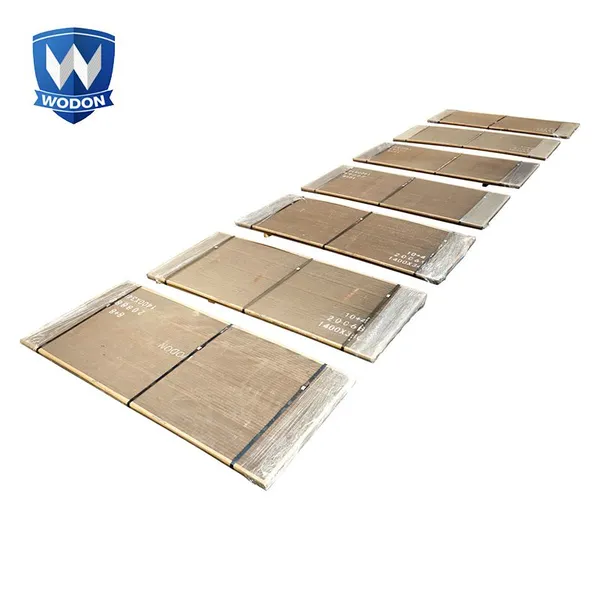
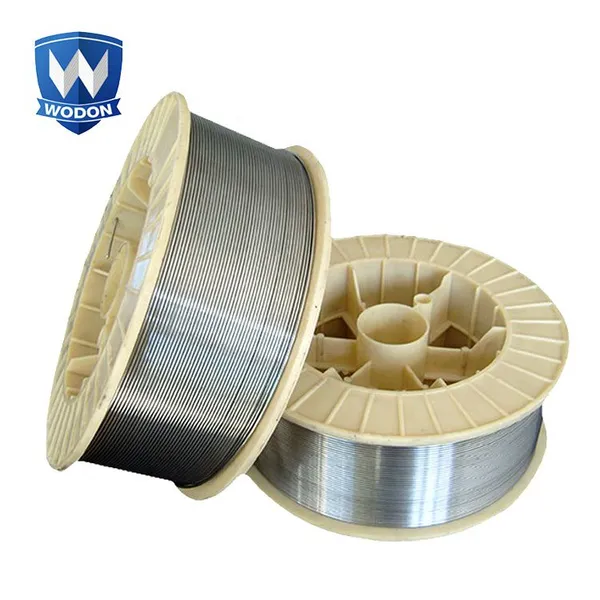
CCO wear plates are prefabricated at the supplier's facility. On site, they are welded or bolted directly to the structure, often in hours rather than days. When the overlay is consumed, the plate can be re-overlaid with hardfacing flux core wire rather than fully replaced.
For plants that reline frequently, the downtime saving of CCO plates is a decisive factor. A chute that takes three days to re-ceramic can often be re-lined with CCO plates in a single shift.
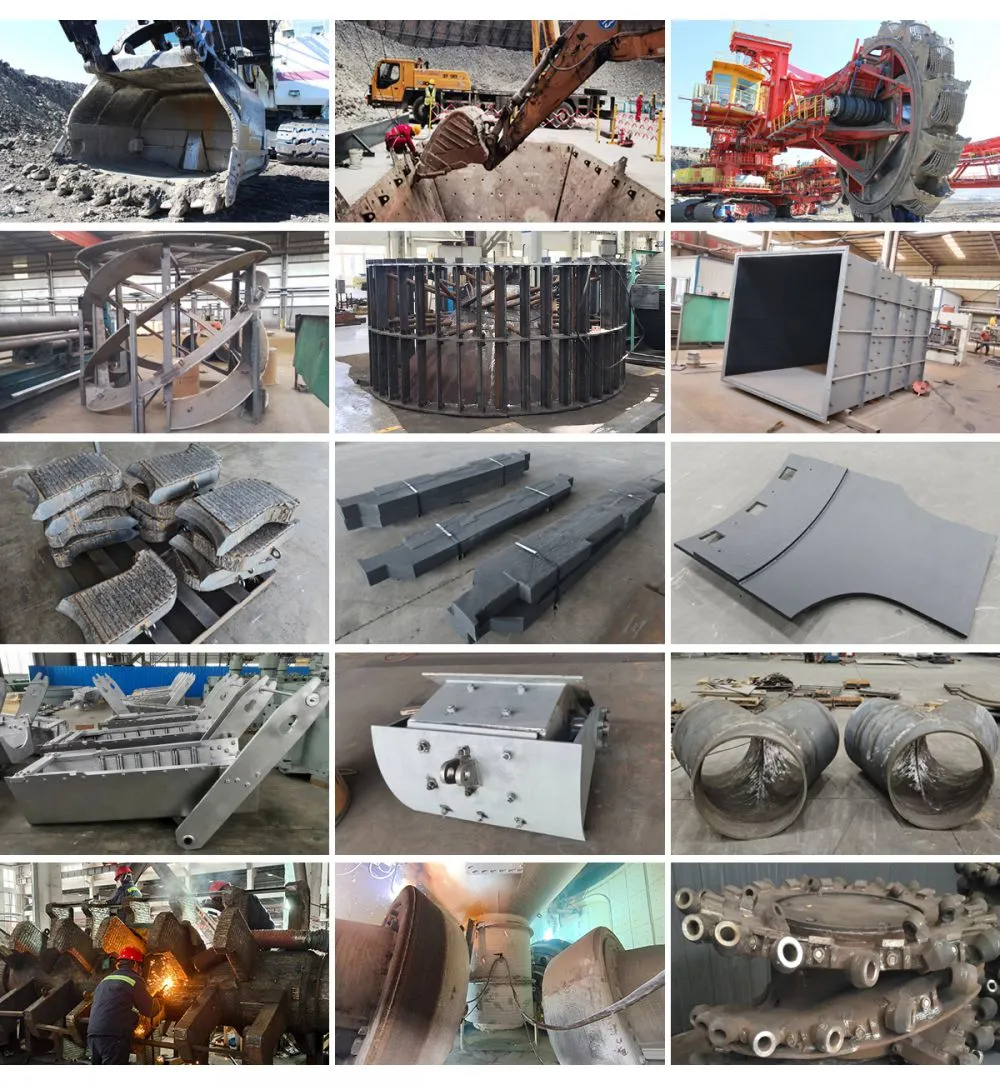
A hybrid design is also common in practice. The impact zones are fitted with CCO wear plate, while the large low-impact surfaces are lined with ceramic tiles to save cost.
The two materials work well together when each is confined to its strength. Jiangsu Wodon Wear Resistant New Material Co., Ltd. routinely supplies CCO impact plates as part of such hybrid chute packages, with cut-to-size plates and drilling completed before shipment.
6. Temperature and Chemical Resistance
Ceramic alumina excels at high temperature. It remains stable at continuous service temperatures above 800°C, which is why it dominates kiln and furnace applications. It is also inert to most chemicals found in mineral processing.
CCO wear plate holds its hardness up to roughly 500°C and is suitable for most material handling temperatures. Above that, the overlay softens and the base plate may lose strength, so hot service beyond 500°C favors ceramic.
For wet or mildly corrosive streams, both materials perform acceptably. CCO plate is a carbon steel product, so aggressive acidic service should be evaluated with the supplier before selection.
Thermal shock is a further consideration. Rapid temperature swings can crack ceramic tiles even within their service temperature range, because alumina has low thermal conductivity and high thermal expansion mismatch with steel. The CCO overlay, bonded metallurgically to its base, tolerates thermal cycling far better. Plants that run intermittent processes with hot material should weigh this factor heavily.
7. Cost Comparison: Initial Price vs. Lifecycle Cost
On a per-square-meter basis, ceramic tile is often the cheaper initial purchase. But initial price ignores the cost of premature failure, relining labor, and production loss. A realistic comparison uses total cost over a defined service period.
| Cost Factor | Ceramic Alumina Lining | CCO Wear Plate |
|---|---|---|
| Material cost per m² | Lower | Higher |
| Installation time | Days, skilled labor required | Hours, standard welding |
| Failure risk in impact duty | High — sudden spalling | Low — gradual wear |
| Repairability | Local tile replacement | Re-overlay on site |
| Lifecycle cost in abrasive + impact duty | Higher | Lower |
An engineering team that tracks cost per tonne of material handled will normally find CCO wear plate economical wherever impact is present, even though its unit price is higher.
Spare parts inventory is a hidden cost that also favors CCO plate. Ceramic installations require stocking multiple tile shapes and sizes, plus adhesive and anchor hardware. A CCO plate inventory needs only a few standard plate sizes and a roll of matching hardfacing flux core wire for repairs. Warehouse space, capital tied up in spares, and the risk of obsolete stock all shrink accordingly.
8. A Field Comparison from Aggregate Processing
An aggregate producer in Eastern Europe ran a direct comparison a while back. Two identical crusher feed chutes handled the same crushed granite at roughly 700 tonnes per hour. One chute was lined with 20 mm ceramic tiles; the other with 8+4 CCO wear plate.
After six months, the ceramic chute showed tile loss at the impact point and required patching twice. After twelve months it was fully re-lined. The CCO-lined chute showed roughly 2 mm of overlay wear at the impact zone in the same period, and the maintenance team projected a total life of about three years. Including labor and downtime, the ceramic option cost the site roughly 2.5 times more per year.
A second example is smaller. A cement plant's bucket elevator casing, lined with ceramic tiles, suffered spalling wherever lumps struck the wall. The plant replaced the casing liners with 6+4 CCO plates, and the spalling issue disappeared entirely for the following two years.
Both cases illustrate the same pattern: ceramic fails fast wherever impact energy is concentrated, and CCO wear plate removes that failure mode entirely. The plants kept ceramic in their fine-material, low-impact sections and moved CCO plate into the impact zones — a pragmatic split that most operators eventually adopt.
9. Decision Guide: Matching the Material to the Duty
The choice comes down to the wear mechanism in your equipment. The decision guide below summarizes the common cases.
| Service Condition | Recommended Solution | Reason |
|---|---|---|
| High impact + abrasion (crusher feed, hoppers) | CCO wear plate | Impact tolerance and predictable wear |
| Pure sliding abrasion, no impact (fine material chutes) | Either | Both perform well; choose on cost and downtime |
| Temperature above 500°C (kiln, furnace) | Ceramic alumina | Heat stability beyond CCO limit |
| Frequent relining, short shutdowns | CCO wear plate | Fast prefabricated installation |
| Very large curved surfaces | Ceramic tiles | Tiles conform easily to complex shapes |
When in doubt, wear-test both materials in a low-risk section of the same chute and measure wear per thousand tonnes. Data from your own plant beats any general recommendation.
Suppliers can support this approach. Wodon Wear Resistant New Material provides sample plates and weld-consumable documentation so a maintenance team can run its own comparison. The company's engineers can also review chute drawings and recommend the lining layout before any material is ordered.
10. FAQ: CCO Wear Plate vs. Ceramic Alumina Lining
10.1 Is ceramic harder than CCO wear plate?
The ceramic tile itself is slightly harder on average, but the comparison is misleading. Ceramic hardness is concentrated in a brittle tile a few millimeters thick; CCO plate hardness comes from carbides in a ductile matrix on a steel base. Under impact, the ceramic loses its advantage quickly through cracking and spalling, while the CCO plate keeps working.
10.2 Can ceramic lining be used on crusher chutes?
Only where the chute is shielded from direct impact or where a sacrificial impact plate absorbs the energy first. Where falling rock strikes the lining directly, ceramic tiles typically crack within weeks. A CCO wear plate, or a hybrid design with CCO impact plates and ceramic on low-impact surfaces, is the more reliable approach.
10.3 Which is more expensive over the life of the equipment?
Ceramic usually costs less to buy but more to own in impact service, because spalled tiles require repeated patching and the exposed steel wears quickly. In abrasive-only duty, ceramic can be economical. In impact-plus-abrasion duty, CCO wear plate almost always delivers a lower cost per tonne processed.
10.4 Does CCO wear plate withstand high temperatures like ceramic?
No. The overlay retains most of its hardness to roughly 500°C, while ceramic alumina serves well above 800°C. For hot gas ducts, kiln components, and furnace internals, ceramic is the appropriate choice. Below 500°C, CCO wear plate offers better impact resistance at a competitive lifecycle cost.
Recently Posted
-
Recent Advances in Chromium Carbide Overlay Technology: Higher Deposition Rates and Finer Microstruc
September 4, 2026A wear plate buyer who ordered the same specification for a decade might assume the product has not changed. In reality, the chrom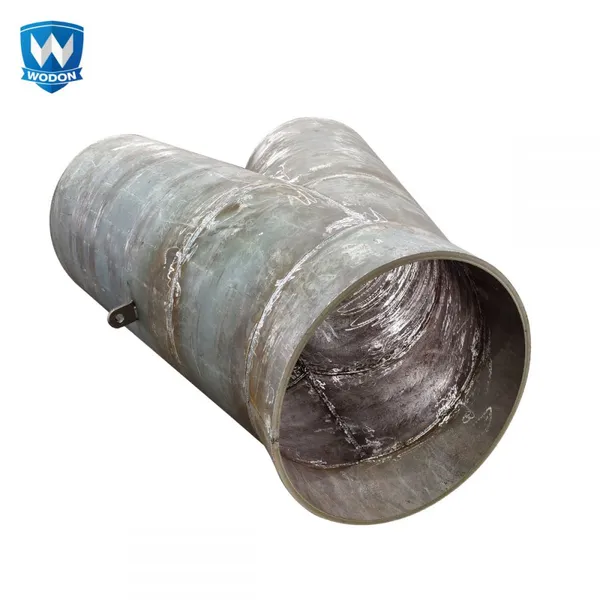 Read More
 -
Chromium Carbide Overlay Wear Plate in Cement Plants: Protecting Fans, Separators, and Ductwork
September 4, 2026A cement plant in North Africa was shutting down its raw mill fan every five months to patch holes worn through the fan casing and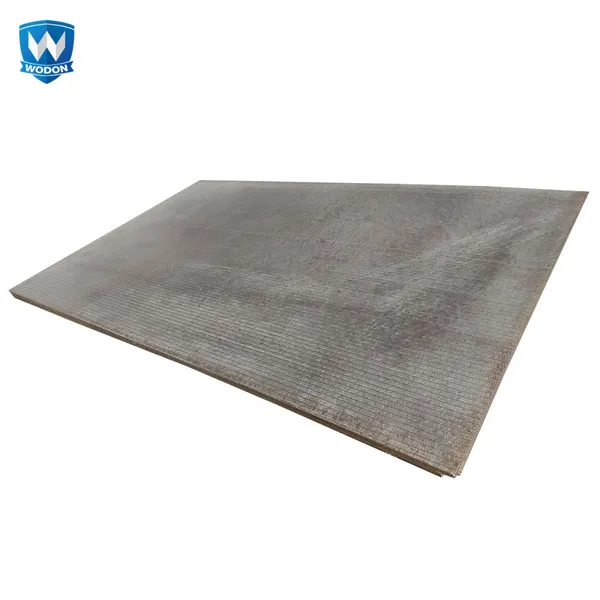 Read More
 -
Selecting Hardfacing Flux Core Wire: 7 Key Parameters to Evaluate Before Buying
September 3, 2026A steel mill maintenance manager ordered a low-priced hardfacing wire for rebuilding crusher hammers, attracted by a price roughly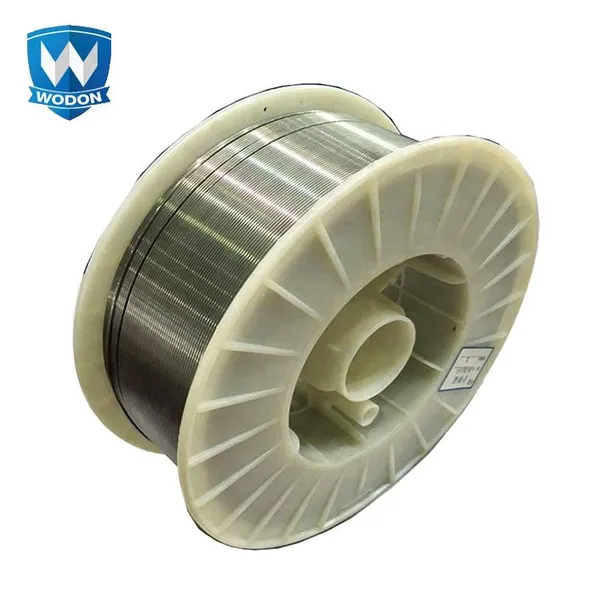 Read More
 -
Understanding CCO Wear Plate: The Bimetallic Structure and Carbide Layer Explained
September 2, 2026A maintenance supervisor at a coal preparation plant watched his transfer chute fail for the fifth time in eighteen months. The 14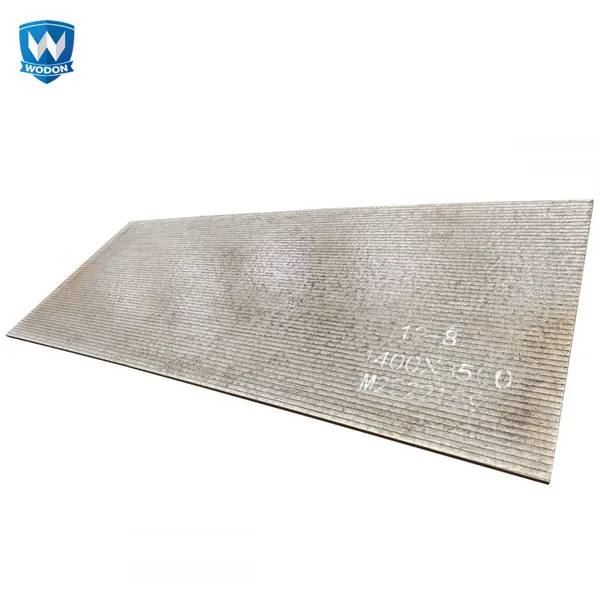 Read More

Contact Us
Recommended Products
-
 Chromium Carbide Overlay Wear Plate WD-1900 Smooth Surface CCO Wear PlateNegotiableMOQ: 1 Square Meter
 -
Hardfacing Wear Resistant Flux Cored Welding Wire With High HardnessNegotiableMOQ: 1 Kilogram
-
High Abrasion Resistant Hardfacing Wear Liners Chromium Carbide Overlay Cco Bimetallic Wear PlateNegotiableMOQ: 1 Square Meter
-
Chrome Carbide Wear Resisting Plate High Wear Steel Plate Wear Liner Platebimetallic Wearable Lining Plate Bucket ExcavatorCHF 300 - 300MOQ: 1 Square Meter
-
Wodon Customizable Steel Flux Cored Welding Wire Manufacturer's Valve Surfacing Gas Shielding OEM SupportUS$ 4.02 - 4.02MOQ: 1 Kilogram
-
Abrasive Resistence Wear Parts Overlay Carbon Chromium Steel PlateNegotiableMOQ: 1 Square Meter
-
Wear Plates for Heavy Duty Mining Applications High Chromium Carbide Overlay Abrasion Resistant and Customizable SizesNegotiableMOQ: 1 Square Meter
-
Hardfacing Truck Liner Plate Chromium Carbide Overlay Wear Plate Cladded PlateNegotiableMOQ: 1 Square Meter
-
Custom Overlaying Wear Plate - Economical Choice for Durable Industrial Applications, High-Quality Fabrication, 55HRC HardnessNegotiableMOQ: 1 Square Meter
-
Wear Abrasion Resistant Overlay High Carbon High Chromium Steel PlateNegotiableMOQ: 1 Square Meter
-
Wear Resistant Steel Plate 6mm 8mm 12mm Thickness Hot Rolled Carbon Steel Plate Wear PlateNegotiableMOQ: 1 Square Meter
-
Bimetallic Cco Clad Composite Overlay Hardfacing Wear Resistant Steel PlateNegotiableMOQ: 1 Square Meter
-
High-Performance Wear Plates for Cement Mills Chromium Carbide Overlay Long Service Life Reliable PerformanceNegotiableMOQ: 1 Square Meter
-
Wear Resistant Steel Plate Liners for Chutes Special Use Wear LinersNegotiableMOQ: 1 Square Meter
-
Cco Hardfacing Surfacing Tungsten Carbide Wear Resistant Plates Liner for SilosNegotiableMOQ: 1 Square Meter
-
Wodon Chromium Alloy Bimetal Hardfacing Plate for Mining MachineryCHF 300 - 300MOQ: 1 Square Meter
-
Hardfacing Abrasion High Wear Resistant Performance Cladding Plate TubeUS$ 399.69 - 399.69MOQ: 1 Square Meter
-
Hardfacing Plates for Manufacture Industry Value High Chrome Wear PlateUS$ 100 - 300MOQ: 1 Square Meter
-
Customizable OEM/ODM Wear-Resistant Soldering & Surfacing Flux Cored Welding WiresUS$ 9.9 - 9.9MOQ: 1 Kilogram
-
Chromium Carbide Round Pipe 6m and 12m Lengths Bending & Cutting Services Welding Technique Saw TechniqueUS$ 6 - 6MOQ: 1 Square Meter